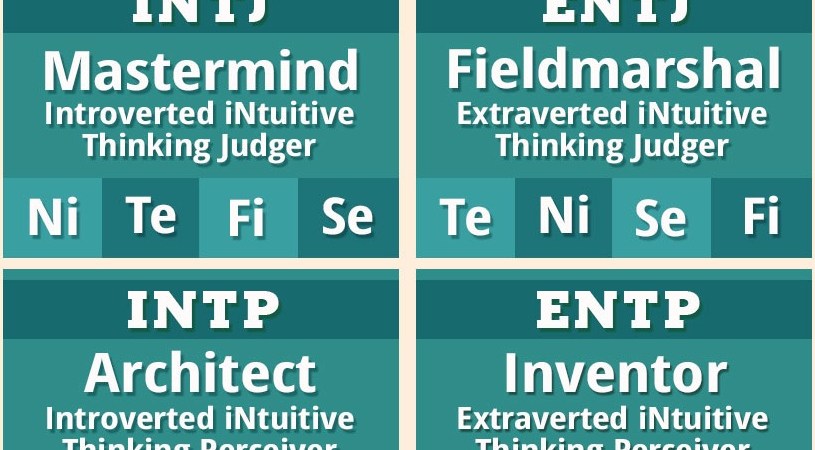
For the avoidance of doubt, I hold a strong degree of skepticism towards anything which attempts to arbitrarily group people in such a way that lends itself to generalisations. In particular, there’s good reason to consider the Myers-Briggs types to be pseudoscientific but attractive in the sense that it seems to give personally tailored advice but arguably anybody could project aspects of themselves onto the results. It is worth noting that a number of scientific reviews have found that it does not With that out of the way…
My partner recently brought up the 16personalities.com quiz, which is something I took a number of years ago. I have hazy recollection as it was a long time ago, but I believe at the time it cast me as an INTJ. I didn’t look much further into it at the time. A few days ago I took the quiz and it gave me INTP instead – “logician”, it claims. I don’t think I put much thought into it either time I took the quiz, but this apparently small change has surprising implications.
Ok, I have to confess, sure, I fall into the stereotype of somebody who is quite introverted. Yes, sure, I have from time to time, analysed and re-analysed things in my head. Ok, I guess I do have a bit of a tendency to read into a subject and then form a bunch of my own theories on it – but who doesn’t?.. it sort of went on like this.
Does it matter if it matches me in reality? I don’t think so. But I think what it has done is to help me reconnect with parts of my identity that maybe I had started to neglect or take for granted simply by pointing them out. Maybe there is actually a value to actually documenting some of my half-baked in incredibly overthought ideas. This is part of what has lead me back to thinking about blogging even though it’s rapidly becoming retro by the second.
The deeper I go into it, the more I seem to be able to tease out about my own psyche.
The INTP type is composed of four main “functions”. In descending order of relevance we have, starting with dominant and auxiliary functions:
- Ti (introverted thinking) – analytical, precise, a tendency to want to invent systems
- Ne (extraverted intuition) – relates to thinking in the future and coming up with ideas
- Si (introverted sensing) – dealing with concrete facts, detecting inconsistencies
- Fe (extraverted feeling) – dealing with shared values and group harmony
I think the Ti and Ne parts are fairly self explanatory. How they interact suggests that an INTP might be someone who wants to build systems which don’t currently exist, that they believe should exist. A less obvious stereotype however is opposition to traditionalism which is something I experience in spades as a republican.
For me where it gets interesting is those lesser functions: Si and Fe. I think the fact that Si is downplayed there is relevant because while I can deal with concrete facts and scrutinise things, it’s not my preferred method of thinking. Potentially the Fe part could be seen as somehow explanatory of my more left-wing political leanings.
However we should tread with caution. Partly because you can look at other personality types and take stuff away from it that you agree with. For instance I also agree with some traits of being a slightly different type that is often seen very differently: the INFP – stereotypes suggest they want to “find their calling” and are very empathetic – and I feel that I can relate to those, too. In fact reading about some of these stereotypes that you are not assigned might help you to find other aspects of your own personality which you can choose to nurture or appreciate.
I think the reality is that while 16 types is a good number, people are weird and fuzzy. It takes quite a lot of information to capture somebody’s personality and pigeonholing people introduces imprecision.
This unfortunately leads to the “dark side” of MTBI. We’ve seen what makes it compelling and some of its strengths and weaknesses when individuals apply it to themselves. But the danger is what happens when others are tempted to apply it to groups, for instance in an employment setting. There is a temptation to say that introverted thinking types might be good scientists, or extrovert feelers might be good teachers – for example. But these are generalisations. From talking to people about their types, many people take on roles which are counterintuitive compared to their given personality type. And they should be allowed to.
MBTI then threatens to exclude competent people from roles for which they are well qualified. Searching around suggests multiple companies attempting to promote this, which in my view is a great shame and not much different from other arbitrary forms of discrimination. There are open questions around how much MBTI might be influenced by e.g. cultural biases – if MBTI does turn out to be a proxy for cultural bias then it is likely to lead to inequitable outcomes for social groups in such a way that turns out to violate equality legislation and generally propagate inequality.
This is far from an original opinion; various scientific reviews seem to agree with me e.g.:
https://journals.sagepub.com/doi/abs/10.1177/009102609202100407
https://aps.onlinelibrary.wiley.com/doi/abs/10.1111/j.1742-9544.1995.tb01750.x
Closing thoughts:
While the MBTI system is intriguing and on a personal level can help you to gain appreciation for your own personality traits, it’s also slightly arbitrary and not necessarily accurate. It should never be used for pigeonholing others and forming generalisations especially in employment contexts.
 2.2 kOhm