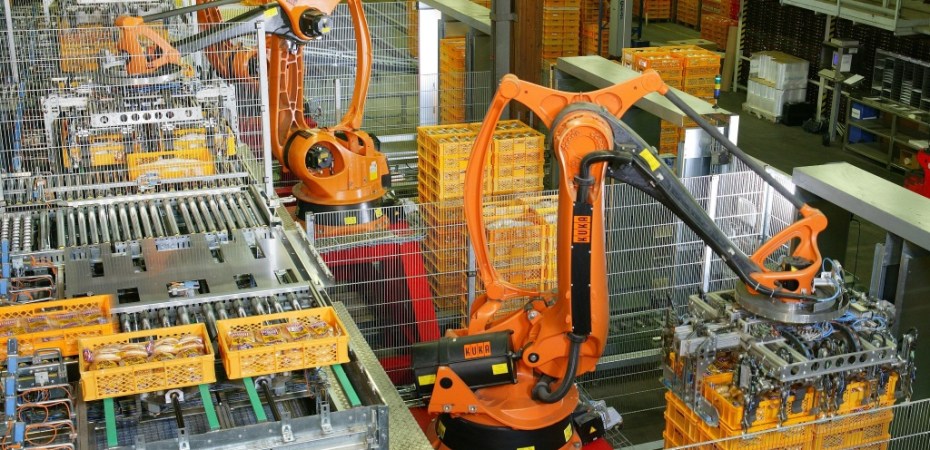
Automation should be a good thing – it should be removing people from work that they don’t want to do, and empowering them to work on things that they want to work on. That should make people happier in their lives and social problems easier to fix. This is a broken promise of the techno-capitalists of Silicon Valley and we need to know how to fix it.
Worker co-operatives may offer a way to mend this broken promise – for the uninitiated, worker co-operatives are organisations which are both owned and controlled by their workers. In a worker co-op, this means that the people working in an organisation can decide on the direction of their workplace, how automation is taken advantage of for their own benefits and how to balance that with the competitive nature of the market.
Much has been said about the prospect of an automated future, where AIs design products which are made in lights-out factories with little-to-no human intervention. I should know, I’ve worked in a company with exactly that kind of aim, and trust me, the intention is not to enrich the employees of the organisation or the communities in which it operates.
Here we are stuck at an impasse, often it is proposed that we should either embrace technology or be left behind by others who do. To be futurists or luddites. Are we to become inhumanly treated Amazon warehouse workers (who are then made redundant) or a Monty Python-esque society in a very muddy looking anarcho-syndicalist commune? Dare I suggest that there may be a middle ground with much fertile ground for us to explore.
In this article in the Guardian, Labour MP Yvette Cooper describes how people believe there is a disconnect between emerging technologies and the policies we are using to keep up with them. Unfortunately it doesn’t really describe any potential solutions to automation – only mentioning that some kind of co-operation between businesses and trade unions should be sought.
Unfortunately, this does not address the real crisis in business today: The ownership crisis. Trade unions are not ownership, neither is representation on a board or anything like that. Without ownership, your representation and rights can be taken away at any moment by a handful of people that you’ve never met and have never worked in your company. Today, trade unions do not frequently work towards the ends of creating worker-ownership, although I would make the case that they should.
The problem that we see when it comes to automation is that it puts all of the productive capability at the very high levels of an organisation. You should imagine a typical organisation to be structured like a triangle, with various levels of management hierarchy near the narrow end at the top and a couple of layers of ordinary workers near the widest part of the triangle at the bottom. You should see automation in the context of businesses today as the power for high-level management to get rid of the lowest layers of their organisation by essentially replacing them with a handful of technologists (or contracted services). For a business owner, this can be very good news as it means getting rid of the largest source of its costs: Its employees.
In this situation, we can see the limitations of the trade unions. Unless they act very early in the process, the trade union only really has the power to stop all human work at the lower levels of the organisational hierarchy. If the automation is already at a ‘good enough’ state in terms of its profitability, the trade union has already had its wings clipped even more so than we already imagine it to be under a Conservative government of eight years. If the trade union acts early and secures the stoppage of automated processes within a firm, the firm will probably be overtaken by another which has not decided against automation. The best thing a trade union could do in this case, assuming no transfer of ownership, is to have the business commit to transferring the employees to a less well developed business sector with a high demand for human capital – unfortunately, there is no way to prevent an employer from simply stabbing the backs of its employees at the last minute when it believes it is automated enough to maintain profitability.
The only solution which works both in the organisation’s interests to keep evolving and competing and in the worker’s interests to not be put out of a job (or have their hours/pay greatly reduced) through automation is to give the workers ownership over the business. This way, workers are the people who decide how the profits from automation are spent. Maybe they choose to work less hours, maybe they choose to develop a different, more manual industry before it can be automated. The point is that it is then the workers who become the direct beneficiary of automation. The combination of private business and trade unionism can never guarantee this to workers, the leverage simply isn’t there.
This describes the necessity of dealing with the crisis of ownership. The fact of the matter is that the entire co-operative sector in the UK only currently employs just over 226k employees as of 2017 – a tiny fraction of the overall labour market. The co-operative party itself is only aiming to double the size of this sector by 2030. The problem is, by this point we may be past the point of no return and the question is: What are we going to do about it?
 2.2 kOhm